
|
Getting your Trinity Audio player ready...
|
REPORT OF A TWO-DAY TRAINING FOR JOURNALISTS WITH DISABILITIES ORGANIZED BY THE CENTRE FOR INFORMATION TECHNOLOGY AND DEVELOPMENT (CITAD)
Date: 14th & 15th November, 2025
Venue: PWD Digital Hub, CITAD
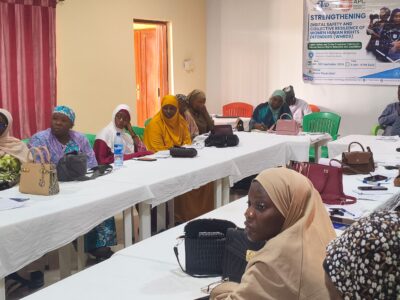
In its efforts to build the capacity of persons with the disabilities, the Centre for Information Technology and Development (CITAD) conducted a two-day capacity-building training for journalists with disabilities in Kano, aimed at strengthening their skills in digital journalism, content creation, digital rights and inclusive digital practices. The training which was held between 14th and 15th of November, 2025 was conducted at the CITAD’s PWD Digital Training Hub. The training brought participants from different disability clusters such as physical, vision impairment, dwarfism etc. working at various media organizations in the state.
In his opening remarks, the Executive Director of CITAD, Engr. YZ Ya’u represented by the Centre’s Campaigns and Communication Officer, Ali Sabo, emphasized that empowering persons with disabilities, particularly with digital skills is a collective responsibility for all organizations. He noted that the world is rapidly moving into a fully digital and AI-driven era, making it essential for everyone to acquire the skills required to compete and thrive. He reaffirmed CITAD’s commitment to building an ICT-literate society and assured that the Centre will continue to ensure that no one is left behind, including persons with disabilities.
In his welcome remarks at the training, Mallam Bala Muhammad of the Department of Mass Communication, Bayero University, Kano commended CITAD for prioritizing disability inclusion and emphasized the critical role of PWDs journalists in telling their own stories and shaping public narratives.
Day One:
The training opened with a session on Digital Rights, led by Ali Sabo, who explained the evolution of journalism in the digital age and the increasing relevance of digital rights for journalists. He outlined key rights including privacy, freedom of expression, and access to information and stressed the need for safe and responsible online engagement. Participants learned practical safety tips such as avoiding suspicious links, using strong passwords, fact-checking information, and adopting responsible posting habits.
Mubarak Shehu Dayyab introduced participants to digital journalism tools and the use of AI such as ChatGPT as assistive technology to improve efficiency and creativity. He also trained participants on Canva for visual storytelling, guiding them through hands-on exercises in designing flyers and digital layouts for news production.
Day Two:
The second day started with recap and participant reflections. Many shared new skills they had gained, including creating videos and identifying AI-generated content such as deepfakes.
After the recap, a session on the Nigeria Data Protection Act (NDPA) was facilitated by Ali Sabo. He provided an overview of the 2023 Act, explained emerging technologies such as AI, IoT, and VR, and discussed the responsibilities of data controllers across sectors including health, finance, education, and government. He also highlighted the regulatory role of the Nigeria Data Protection Commission (NDPC).
The second technical session was on Digital Inclusion, Hamza Aminu, CITAD PWDs Coordinator emphasized the need to ensure equal access to digital tools, accessible content, and barrier-free media participation for persons with disabilities.
The final practical session, led by Mubarak Shehu, focused on designing social media content for news stories. Participants worked in groups to create visuals for selected headlines and presented their digital designs.
The two-day training significantly enhanced the digital capacity of PWD journalists, equipping them with practical skills in digital rights, data protection, AI-assisted journalism, and visual content creation. The combination of theoretical learning, hands-on exercises, and interactive discussions ensured that participants left with improved confidence and stronger competencies for digital media work.
CITAD remains committed to promoting digital inclusion and empowering journalists with disabilities to participate fully and effectively in Nigeria’s digital and media ecosystem.